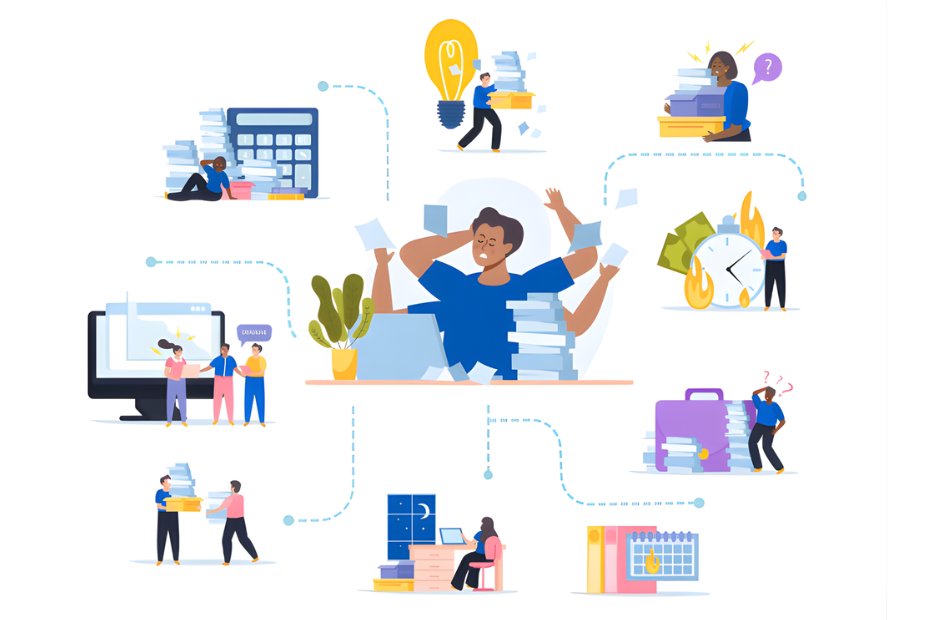
Ambitious startups often begin with speed in mind, and hiring multiple freelancers can appear to be the quickest route to building a product. Individual specialists promise flexibility, lower upfront cost, and immediate availability. Yet beneath that convenience lies a structural question that many founders overlook until problems surface. When several independent contributors are responsible for critical components of a single product, who ensures cohesion, accountability, and sustained quality?
Where Fragmentation Begins
Early hiring decisions often feel practical. A freelance developer handles backend work, a designer works on user flows, and a contract QA specialist reviews releases. At first glance, this structure seems efficient. However, the risks of hiring multiple freelancers begin to surface when ownership becomes unclear, and coordination becomes a daily operational burden rather than an occasional check-in.
Many founders underestimate the complexity of managing remote teams composed of independent contractors. Each freelancer operates within their own schedule, tooling preferences, and communication style. Without centralized technical leadership, integration gaps quietly accumulate. Misalignment between architecture decisions and product vision creates friction that slows progress over time.
Over time, this structure creates friction that slows progress and weakens delivery consistency. Fragmentation rarely looks dramatic in the early stages, yet it gradually erodes predictability and execution discipline.
Hidden freelancer coordination issues also influence decision-making. When responsibilities overlap, accountability diffuses. When responsibilities do not overlap, critical blind spots appear. In both cases, the product suffers.
Why Do Multiple Freelancers Often Lead To Startup Project Misalignment?
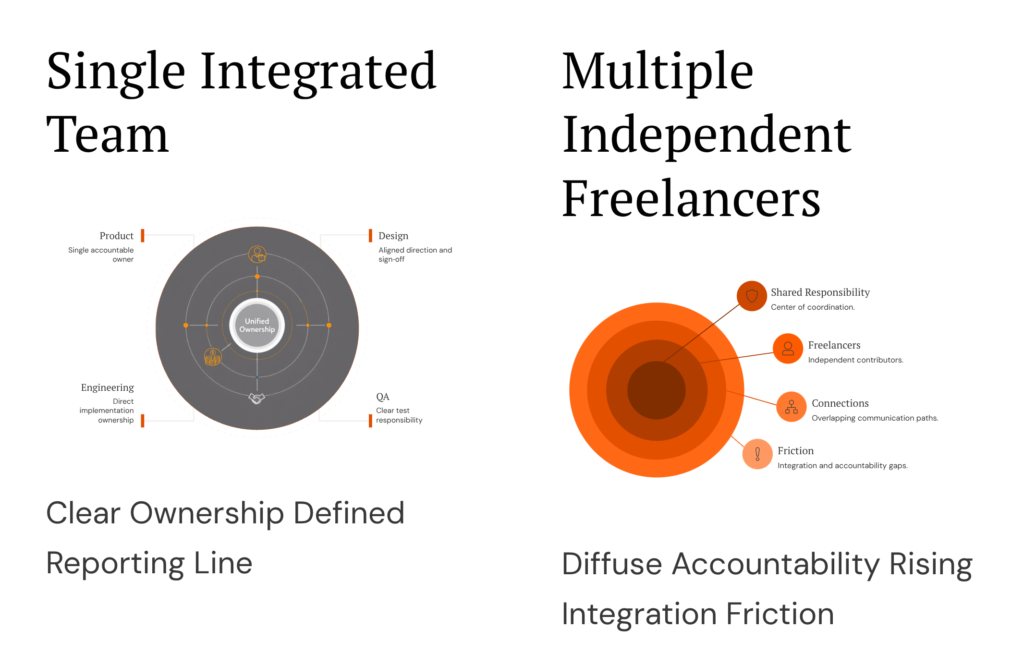
Multiple freelancers often lead to startup project misalignment because independent contributors rarely share unified accountability for long-term product outcomes.
Freelancers typically focus on completing defined tasks rather than shaping systemic architecture. This structure encourages the delivery of individual components without continuous alignment around shared technical standards. Over time, technical debt with freelancers accumulates as short-term solutions replace thoughtful engineering decisions.
Research from the 2023 Accelerate State of DevOps Report by Google Cloud shows that teams with strong engineering discipline and cohesive collaboration models consistently outperform fragmented structures in deployment frequency and recovery speed. Integrated teams standardize practices, reduce rework, and maintain architectural coherence. Fragmented setups, by contrast, spend increasing effort resolving inconsistencies and managing coordination gaps. (source)
Another risk lies in inconsistent documentation and evolving code conventions. One freelancer may implement rapid fixes without documenting reasoning. Another may refactor without full awareness of earlier constraints. These small disconnects compound into larger startup execution challenges, especially as feature complexity increases.
When no single group is accountable for system integrity, responsibility shifts from building product value to resolving integration friction.
Practical Warning Signs To Watch
The following patterns frequently signal structural instability when multiple freelancers are involved:
- Diffuse Technical Ownership- Responsibility for architecture and code quality becomes shared informally rather than assigned clearly. When issues arise, resolution depends on coordination across several independent contributors. Over time, this weakens the foundation of a reliable software team.
- Rising Integration Friction- Separate modules require frequent rework to align APIs, naming conventions, and performance standards. Integration begins to consume a significant portion of sprint cycles. Productivity declines even if individual freelancers perform well in isolation.
- Escalating Technical Debt- Quick fixes and inconsistent architectural decisions accumulate silently. Without centralized code review standards, technical debt with freelancers grows and becomes expensive to unwind. This often surfaces during scaling or fundraising due diligence.
- Strategic Drift- Product direction evolves as different contributors interpret requirements independently. Alignment meetings increase, yet clarity decreases. The absence of a unified product perspective intensifies startup execution challenges.
Each of these signs points toward structural misalignment rather than individual capability gaps.
What Improves With An Integrated Structure
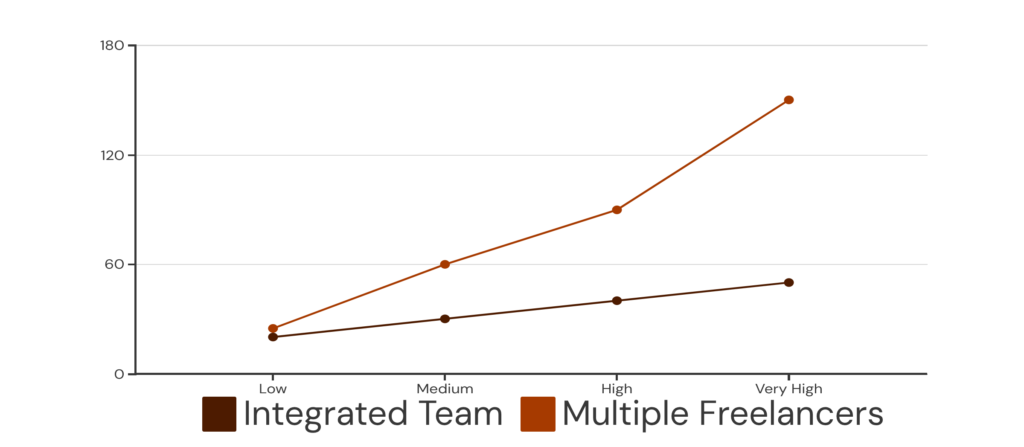
When startups transition toward an integrated delivery model, execution quality changes noticeably. A cohesive team with shared accountability replaces scattered coordination threads. Communication becomes structured rather than reactive.
A dedicated internal group or an experienced product-building company provides unified technical leadership and shared standards. Engineering practices become consistent. Documentation improves. Architectural decisions are evaluated against long-term goals rather than immediate task completion.
This structure strengthens startup execution because clarity replaces ambiguity. Decision cycles shorten. Quality reviews become systematic. Dependencies are visible and managed proactively. Product performance improves through coordinated iteration rather than patchwork updates.
Integrated teams also create measurable efficiency gains. Research from McKinsey indicates that high-performing engineering organizations emphasize cross-functional collaboration and disciplined delivery processes, leading to stronger throughput and fewer defects. These characteristics are difficult to replicate when freelancers operate independently.
A structured approach does not eliminate flexibility. Instead, it channels flexibility into coordinated progress.
Bottom Line
Freelancers can provide valuable expertise, especially for short-term or highly specialized work. However, when core product development depends on multiple independent contributors, structural risks quietly accumulate beneath the surface. Fragmented ownership, inconsistent engineering decisions, and evolving communication gaps rarely create immediate failure, yet they steadily weaken execution discipline as complexity grows.
A thoughtful way forward involves evaluating structure before expanding headcount. Founders who prioritize integrated leadership, documented engineering practices, and unified product direction reduce long-term execution risk. Instead of coordinating scattered contributors, the focus shifts toward disciplined delivery, architectural coherence, and measurable progress.
If your priority is sustainable growth and confident startup execution, consider partnering with Toolagen Technology Services as a trusted product-building partner that brings integrated engineering ownership and structured execution discipline to every stage of product development.
FAQs
- What Are The Risks Of Working With Multiple Freelancers?
The primary risks include coordination breakdowns, inconsistent code standards, and fragmented accountability. These factors contribute to startup project misalignment and can weaken long-term execution stability.
- How To Manage Remote Freelance Teams Effectively?
Effective oversight requires clear documentation, centralized technical direction, and structured communication routines. Many founders address managing remote teams’ challenges by engaging with a startup product-building partner like Toolagen Technology Services to build a reliable software team with shared accountability.
- Can Freelancers Slow Down Startup Execution?
Freelancers can move quickly on isolated tasks, yet integration overhead and coordination friction may slow overall startup execution as complexity increases. A unified structure may help reduce these delays.
- How To Avoid Technical Debt With Freelancers?
Establish shared coding standards, enforce regular code reviews, and maintain clear architectural guidelines from the start. Consistent documentation, version control discipline, and defined ownership of system components help prevent fragmented decisions that gradually accumulate into technical debt.
- Are Freelancers Suitable For Long Term Product Builds?
Freelancers can support specific short-term needs, but long-term product development often benefits from a structured, reliable software team. Tech partners for startup like Toolagen Technology Services provides integrated delivery models designed to sustain product quality and execution continuity.