
Securing founder funding during product development is one of the most strategically important phases for a startup. At this stage, the product is evolving, user validation is emerging, and key decisions around scalability and market positioning are taking shape. Yet this is precisely when meaningful startup funding conversations begin, not just to pitch a solution but to demonstrate structured thinking, risk reduction, and execution discipline.
Investors do not evaluate passion alone. They assess how intelligently founders can navigate uncertainty, validate assumptions, and build momentum. This means that preparing for investor meetings requires more than arranging polished slides; it demands strategic clarity, measurable progress, and credibility.
What Investors Really Evaluate Early On
When investors consider a funding opportunity during MVP development, they evaluate risk across three core dimensions: market validation, product viability, and execution capability. A credible presentation reduces perceived risk by showing measurable traction, disciplined iteration, and understanding of competitive dynamics.
According to early-stage investor evaluation frameworks, founders should be prepared to answer detailed questions about market size, financial forecasts, and business model assumptions, not simply provide an elevator pitch, because those data-driven insights strengthen confidence in your readiness for investment. (source)
Investors also prioritize founder adaptability. They seek validation that entrepreneurs can navigate ambiguity, communicate clearly under pressure, and integrate learning into product decisions.
How the MVP Shapes Funding Discussions
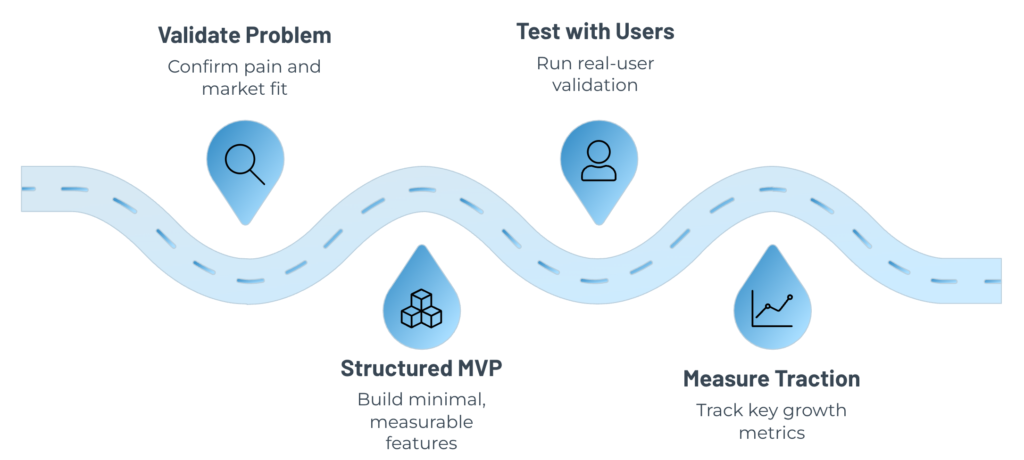
One of the most common questions founders face is what investors expect from a prototype. An MVP is not simply a version of the final product; it is a tool for real-world validation.
Experienced startup advisors emphasize that an effective MVP should demonstrate problem-solution fit in a way that is immediately intelligible to investors. This means clearly showing who your user is, why the problem matters, and how your product resolves it. (source)
Although features are important, investors focus on whether the MVP generates credible user engagement or early feedback that supports assumptions about future product potential. Evidence of demand strengthens early traction and supports your early-stage investor strategy.
Structuring Your Funding Narrative
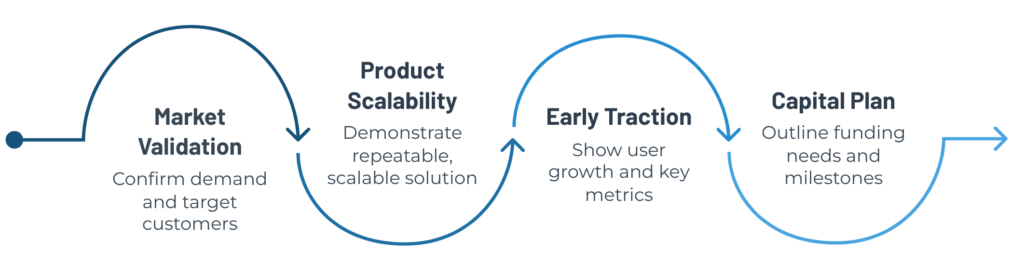
When pitching with MVP, your narrative should follow a logical sequence that reflects strategic thinking and readiness. Investors are impressed when founders clearly articulate the problem, show early validation, and position capital needs as direct accelerators of measurable progress.
A professional approach to founder funding includes:
- Demonstrating validated market demand and early traction
- Presenting a realistic roadmap with milestones tied to capital deployment
- Showing that financial assumptions are grounded in data and trend insights
- Clearly explaining how additional funds will de-risk future milestones
This level of preparation communicates seriousness about execution and growth.
Clarifying Traction and Demonstrating Momentum
One of the most critical elements of impressing investors is demonstrating momentum, even if revenue is not yet significant. Early traction can appear through user growth, repeat engagement, or structured pilot adoption, all of which signal product-market resonance.
Investors look for a strong connection between your solution and measurable user value. This alignment reassures them that your solution addresses a real need and that the path to sustainable growth exists.
In startup funding contexts, traction metrics do not require scale; they require consistency and evidence of learning. Demonstrating structured testing, rapid iteration, and validated assumptions shows intelligent progress.
Technical Credibility and Strategic Product Development
With technology products, product readiness for investors includes demonstrating technical reliability and scalability. A well-structured MVP built to handle real use cases signals reduced execution risk.
Engaging an experienced MVP development company such as Toolagen Technology Services can significantly strengthen this foundation. A capable technical partner helps establish scalable architecture, performance resilience, integration flexibility, and security standards aligned with growth objectives. Investors recognize when a product has been intentionally engineered for scale rather than rapidly assembled to meet short-term milestones.
Demonstrating technical clarity and structured development practices makes it substantially easier for investors to evaluate long-term scalability, capital efficiency, and expansion potential.
Avoiding Strategic Mistakes
Understanding common missteps is equally important when navigating startup investor tips.
Overly optimistic projections without supporting assumptions weaken credibility. Unclear capital allocation plans raise concerns about execution discipline. Defensive responses during questioning signal a lack of preparedness.
Professional founders approach investor dialogue as a strategic exchange rather than a presentation. They acknowledge risks, demonstrate mitigation strategies, and remain composed under scrutiny.
Final Thoughts
Preparing for investor conversations during product development is not simply about refining a pitch; it is about demonstrating maturity in how you reduce risk, validate assumptions, and allocate capital with intent. Securing startup funding and meaningful founder funding depends less on optimism and more on evidence: validated demand, disciplined execution, measurable traction, and a clearly articulated growth roadmap.
Investors ultimately invest in judgment. They assess whether founders understand their market, build with technical discipline, and deploy capital responsibly. A structured MVP built for real-world use signals operational seriousness. Collaborating with a capable startup product development partner such as Toolagen Technology Services can further strengthen architectural scalability, performance reliability, and long-term product readiness, all of which materially influence investor confidence.
The thoughtful way forward is to treat investor preparation as a strategic capability rather than a one-time fundraising exercise. Strengthen technical foundations. Continuously validate market assumptions. Align product development with capital efficiency and milestone clarity.
When preparation reflects foresight and execution control, investor conversations shift from persuasion to partnership, and funding becomes a logical next step, not a hopeful outcome.
FAQs
- How should I prepare for investor conversations?
Validate your assumptions with data, define a clear capital roadmap, and be ready to address scalability and risk. Partnering with a startup product development expert like Toolagen Technology Services can also strengthen product readiness and technical credibility before investor meetings.
- What do investors expect from an MVP?
Investors expect an MVP to demonstrate problem-solution fit, early validation, and evidence of real user engagement rather than feature completeness.
- How can I showcase my product during fundraising?
Present the product in terms of outcomes and value creation. Highlight user validation, measurable traction, and how additional capital accelerates progress.
- What mistakes should I avoid in investor meetings?
Avoid unrealistic projections, unclear funding allocation, and defensive communication. Investors prioritize analytical thinking and structured reasoning.
- How do I demonstrate traction to investors?
Demonstrate traction through user growth trends, pilot program outcomes, repeat engagement metrics, and validated learning milestones. Working with a tech partner for startups like Toolagen Technology Services can also help structure measurable testing frameworks and performance benchmarks that strengthen credibility during investor discussions.