
Ambitious founders often assume that larger teams automatically translate into faster execution and broader capability. In reality, product success is shaped far less by headcount and far more by clarity, ownership, and disciplined collaboration. When team structures create friction, even highly skilled engineers struggle to deliver consistent outcomes. Understanding why dedicated startup pods consistently outperform large outsourcing structures helps founders build products with greater confidence and long-term stability.
The Hidden Challenges with Large Outsourcing Teams
Large outsourcing vendors often promote scale as their primary advantage. A bigger bench of engineers reduces risk and accelerates timelines. However, as team size increases, coordination complexity grows exponentially. Every additional contributor introduces new communication pathways, which increases the likelihood of misalignment.
Research in software engineering has repeatedly shown that communication overhead rises sharply as team size grows, reducing productivity gains from adding more contributors. A widely cited empirical study published in Empirical Software Engineering found that larger teams experience diminishing returns due to increased coordination demands. (source)
When context passes through multiple intermediaries, product intent becomes diluted. Requirements are reinterpreted, decisions are delayed, and accountability becomes unclear. Over time, this fragmentation weakens what should be a reliable software team.
Founders often encounter hidden consequences such as inconsistent quality standards, unclear responsibility for defects, and slower product pivots. These issues rarely appear during vendor selection but surface during scaling phases when execution discipline matters most.
How Smaller Teams Deliver Better Outcomes?
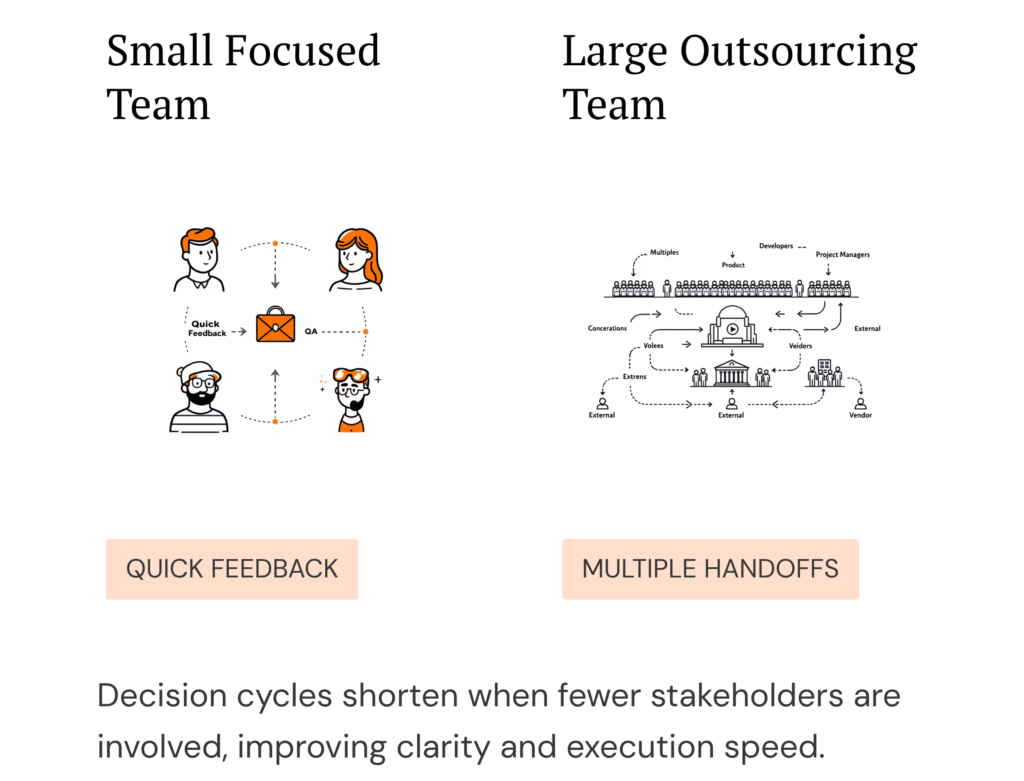
Smaller teams deliver stronger outcomes by reducing friction and strengthening ownership.
McKinsey’s Developer Velocity research demonstrates that organizations emphasizing empowered, well-structured engineering teams outperform peers in software delivery and business impact. High-performing organizations prioritize clarity of roles, streamlined decision making, and tight collaboration loops. (source)
Complementing this, research published in IEEE Software highlights that small, cross-functional teams maintain better coordination and shared understanding compared to large distributed groups, directly influencing delivery quality and predictability. (source)
These findings reinforce the structural advantage of focused development teams. When engineers operate within compact groups, communication becomes direct, feedback cycles shorten, and shared accountability strengthens execution discipline.
The discussion around outsourcing vs in-house product teams often centers on geography or cost, yet structure and ownership play a greater role. Teams that function as integrated product partners with stable composition outperform large transactional outsourcing arrangements regardless of location.
How Dedicated Pods Improve Execution
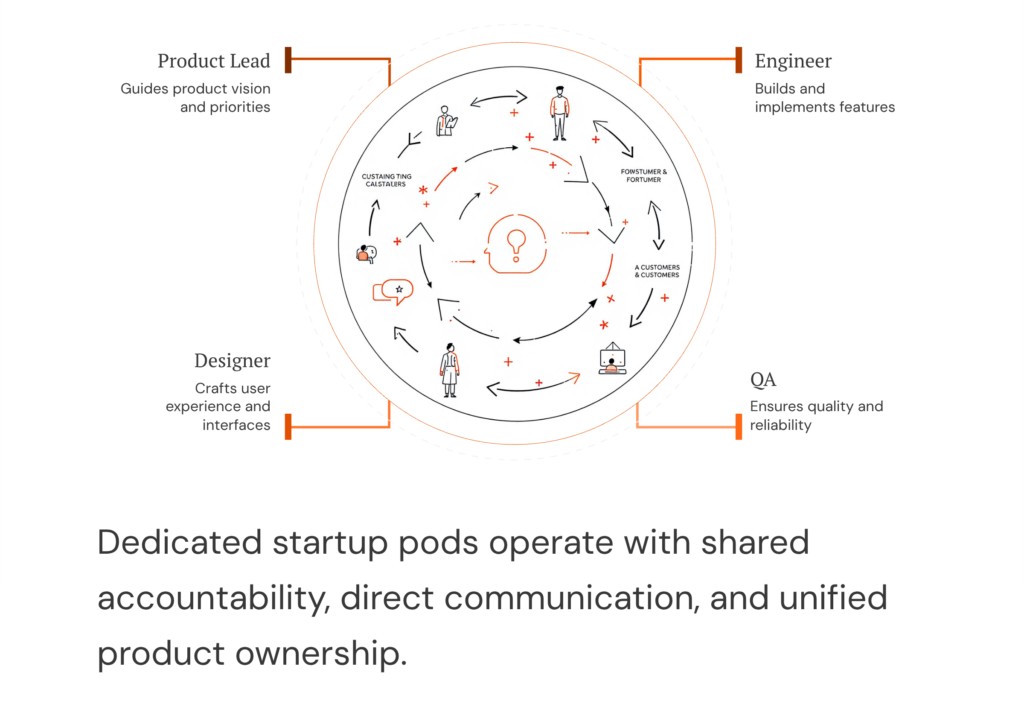
Organizations that implement dedicated pods for better output shift from fragmented vendor relationships to cohesive product squads. Pods consist of small cross-functional teams aligned to a specific mission with long-term responsibility.
Stable team composition allows institutional knowledge to compound. Engineers develop deep product context, architectural decisions remain coherent, and roadmap planning becomes realistic. This directly improves startup team efficiency because less time is spent re-explaining requirements or resolving misinterpretations.
Compact structures also reduce dependency chains. Decisions happen closer to execution, minimizing delays caused by layered approvals. Over time, this structural clarity strengthens performance consistency and delivery predictability.
The disciplined collaboration within focused engineering teams supports sustainable growth without increasing organizational complexity.
Practical Advantages Of Focused Engineering Teams
The following are the practical advantages of focused engineering teams that directly strengthen product execution and long-term scalability:
- Clear Ownership and Accountability– Smaller pods make responsibility visible. Each member understands their role in delivering outcomes, which reduces ambiguity and strengthens delivery reliability.
- Efficient Communication Loops– Compact groups significantly reduce coordination overhead. This improves startup team efficiency by minimizing context switching and enabling faster problem resolution.
- Embedded Quality Discipline- Teams organized around quality-first development integrate testing, code reviews, and architectural foresight into daily workflows. Quality becomes a continuous practice rather than a late-stage correction.
- Strategic Product Alignment– Members of focused development teams stay closely connected to product vision and roadmap priorities. This alignment reduces rework and supports coherent long-term scalability.
The Compounding Effect Of Small Team Startup Advantages
One of the most powerful Small team startup advantages is cumulative clarity. When a compact pod consistently delivers predictable releases, confidence grows among founders, investors, and customers. Stable execution strengthens planning accuracy and reduces reactive firefighting.
A structure built around dedicated startup pods avoids frequent personnel rotation common in large outsourcing arrangements. Continuity preserves context, strengthens architecture, and improves future estimation accuracy.
Adaptability improves as well. Smaller teams can pivot quickly, integrate feedback efficiently, and maintain momentum without navigating excessive approval layers. This responsiveness enhances product market alignment while preserving engineering discipline.
What Changes When The Structure Is Right
When founders adopt dedicated pods for better output, roadmaps become transparent and achievable. A truly reliable software team demonstrates consistent velocity because ownership and communication remain clear.
Execution quality strengthens under quality-first development because technical excellence becomes embedded in everyday work. Testing, review discipline, and architectural planning are integrated into delivery cycles, reducing long-term technical debt.
Sustainable growth depends on a structure that promotes clarity and accountability rather than expanding headcount without cohesion. Teams that operate with shared responsibility and stable alignment consistently deliver stronger products than larger, loosely coordinated outsourcing groups.
Final Thoughts
Product success rarely hinges on how many engineers sit on a project. It depends on how clearly they understand the mission, how directly they communicate, and how consistently they take ownership of outcomes. Structure shapes behavior, and behavior shapes product quality.
When teams are organized into dedicated startup pods, clarity becomes operational rather than aspirational. Decisions move faster because the same group that plans the work executes it. Accountability strengthens because ownership is visible. Over time, this discipline compounds into stronger architecture, predictable delivery, and healthier product evolution.
Founders evaluating outsourcing vs in-house product teams should look beyond cost comparisons and focus instead on alignment, continuity, and execution standards. A team built around quality-first development and supported by stable, focused engineering teams creates an environment where product decisions are thoughtful and scalable.
A practical next step is to assess whether your current structure supports ownership and clarity or whether it diffuses responsibility across too many layers. If alignment, execution discipline, and long-term product reliability matter to your growth plans, working with a startup product-building partner like Toolagen Technology Services that operates through dedicated startup pods can provide the structural foundation needed for sustained performance.
The advantage of small, focused teams is not about size alone. It is about intentional design. And intentional design is what ultimately determines whether a product grows steadily or struggles under its own complexity.
FAQs
- Why do small teams often perform better than large outsourced teams?
Small teams minimize coordination overhead and strengthen ownership, which improves predictability and product quality. Working with a Co-building partner like Toolagen Technology Services enables structured pods that stay aligned with product goals instead of operating as disconnected vendors.
- What is a dedicated startup pod?
Dedicated startup pods are compact cross-functional units assigned to a defined product mission with long-term accountability. They combine engineering capability, product thinking, and embedded quality oversight within one cohesive structure.
- How to structure a focused team for a startup?
Begin with a clearly defined product objective, assign direct ownership, and maintain stable roles within a compact team. A tech partner for startups like Toolagen Technology Services can help design pod structures that optimize startup team efficiency and delivery reliability.
- Can small teams scale products effectively?
Yes, because architectural clarity and disciplined ownership enable predictable scaling. Focused engineering teams build systems that support growth without sacrificing cohesion or execution quality.
- How does quality-first development benefit small teams?
Quality-first development embeds testing, reviews, and architectural discipline into daily work, reducing rework and improving reliability while keeping the codebase scalable and maintainable.