
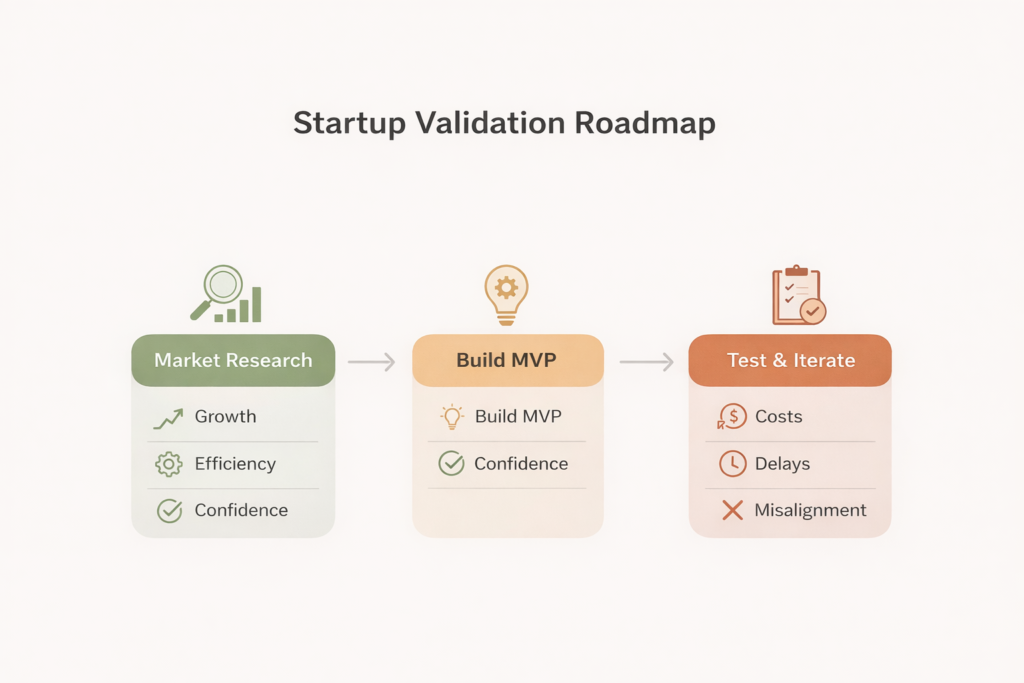
Founders often feel an unspoken pressure to move straight into building, especially when early excitement or internal alignment creates momentum. That pressure can quietly replace careful validation with rushed execution, leaving critical assumptions untested. A more deliberate approach allows teams to learn early, protect resources, and build confidence based on evidence rather than optimism.
Why Early Product Decisions Feel Uncomfortably Heavy
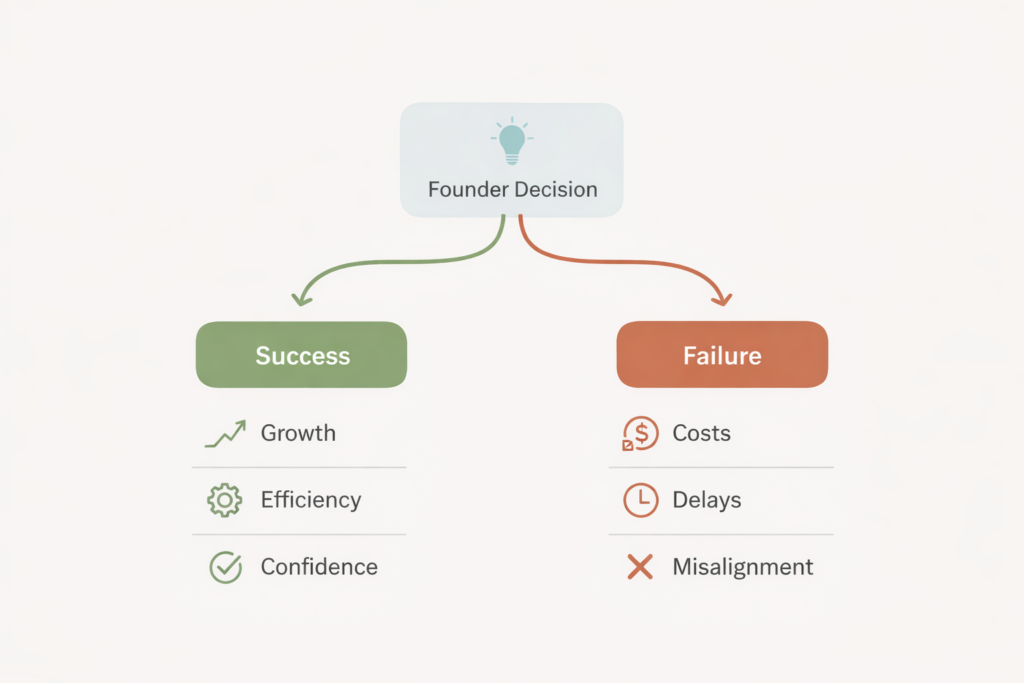
At the earliest stages, every product decision carries amplified consequences because budgets are tight and timelines feel unforgiving. When validation is skipped or rushed, teams risk building solutions that solve problems users never prioritized. Data published by CB Insights shows that lack of market need remains one of the most common reasons startups fail, which highlights how costly untested assumptions can be. (source)
The emotional cost is often overlooked, since teams can become deeply attached to features before confirming their relevance. This attachment makes change harder later and increases exposure to wasted effort. Addressing this tension early is why validating product ideas for startups should be treated as a core responsibility rather than an optional step.
Why Is Early Validation More Effective Than Full Builds?
Early validation works because it focuses on learning instead of completion, allowing teams to observe real behavior before committing to scale. Rather than asking users what they might do, founders design small experiments that reveal what users actually do when faced with a proposed solution. Guidance from the Nielsen Norman Group explains how usability testing and lightweight prototypes uncover issues long before full development begins. (source)
This approach also benefits from listening closely to how users describe their problems. Paying close attention to the language users naturally use during interviews and onboarding flows helps align product messaging with real expectations. These insights reduce misinterpretation while keeping validation grounded and efficient.
Expert Guided Principles That Strengthen Validation
The following are expert-guided principles that help founders validate ideas with clarity, discipline, and measurable learning while reducing unnecessary build effort:
- Intentional Experiment Design– Validation improves when experiments are designed to answer one clear question at a time. An experienced MVP development company often helps founders define these questions before any build work starts. This focus ensures that learning remains clean and actionable.
- Behavior First Feedback Methods– Reliable insights come from observing usage rather than collecting opinions in isolation. Well-structured early user feedback strategies include usability walkthroughs, task-based testing, and monitored trials. These methods expose friction points that users may never articulate directly.
- Metrics Anchored Iteration– Each iteration should be guided by measurable outcomes rather than feature ambition. Practical MVP validation tips emphasize tracking engagement, completion rates, or repeat usage to assess value. This keeps validation objective and decision-making grounded.
- Shared Ownership Models– Validation accelerates when builders and founders share responsibility for outcomes. Many teams adopt co-building startup approaches to maintain alignment between discovery and delivery. This structure reduces rework and shortens learning cycles.
Preventing Overbuilding Before It Starts
Overbuilding usually stems from uncertainty rather than ambition, since founders often add features to compensate for unclear signals. This behavior increases complexity without increasing confidence. Avoiding this trap requires discipline and a willingness to test incomplete solutions.
Teams that succeed prioritize testing ideas without overbuilding through prototypes, manual workflows, or limited releases that simulate the experience. Research shared by the Interaction Design Foundation explains how low-fidelity prototypes deliver insight with minimal cost. (source)
This approach naturally supports avoiding product waste, because features earn investment only after demonstrating relevance. Over time, validation-driven teams build with greater precision and fewer reversals.
How The Right Collaboration Improves Outcomes
Working with a startup product development partner who understands validation reduces the gap between insight and execution. Instead of measuring success by output volume, the partnership centers on learning milestones and adaptability. This improves reliability while keeping progress steady.
Many founders also choose co-building startups for validation, where shared accountability ensures that feedback informs both strategy and delivery. Open guidance from the Lean Enterprise Institute highlights how iterative experimentation strengthens long-term performance. (source)
FAQs
- How do I validate a product idea without overbuilding?
Start by identifying the assumption that carries the most risk and design a small experiment to test it. Prototypes, landing pages, or concierge-style services allow learning before full development. Startup product development partners like Toolagen Technology services often help founders structure these experiments for clarity and speed. - What is the MVP validation process?
The process involves defining a hypothesis, creating a minimal representation to test it, and measuring real user behavior. Outcomes then guide iteration or refinement. This ensures learning drives progress rather than guesswork. - How to collect early user feedback effectively?
Effective feedback comes from observing users complete realistic tasks. Combining interviews with usability testing quickly reveals friction and confusion. These insights are more reliable than survey responses alone. - Can I test ideas without coding a full product?
Yes, many teams validate through no-code tools, mock interfaces, or manual processes that simulate the experience. These methods reduce risk while preserving flexibility. Tech partners for startups like Toolagen Technology Services regularly supports founders in choosing the right level of build. - How do co-building startups help in validation?
A co-building approach aligns founders and builders around shared learning goals. This structure improves responsiveness to feedback and reduces wasted effort. It also strengthens accountability throughout validation.
Final Thoughts
Validation becomes easier when learning is treated as a structured practice rather than an afterthought. Teams gain confidence, reduce waste, and make better decisions when evidence guides execution. For founders seeking a disciplined validation approach supported by experienced collaboration, working with Toolagen Technology services can help transform early uncertainty into informed progress without unnecessary build complexity.