
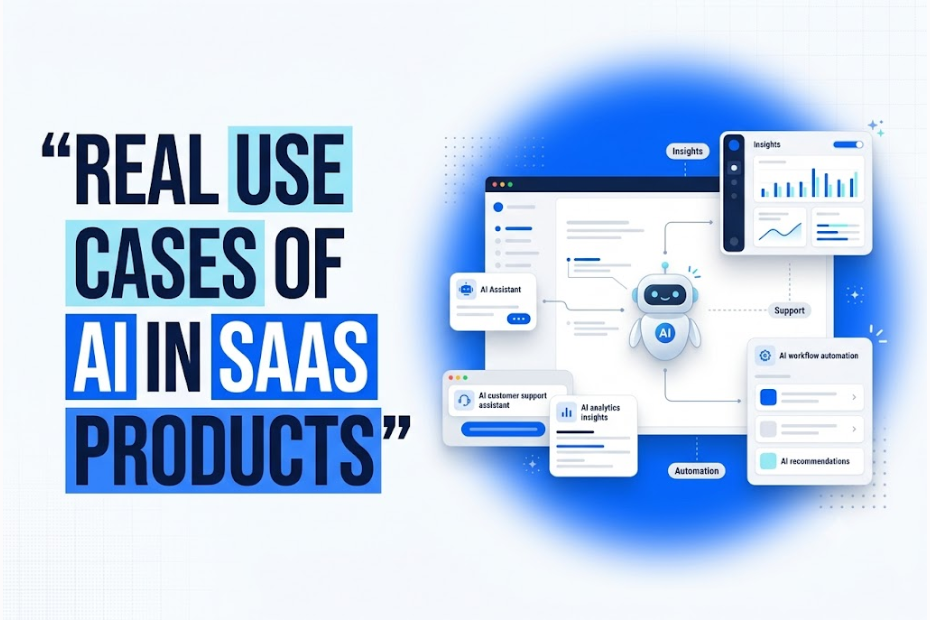
Artificial intelligence has moved beyond being a feature that sounds impressive on a product page. Today, SaaS companies are exploring practical ways to use AI to solve real customer problems, improve workflows, and create better product experiences. The strongest examples of AI in SaaS products are not built around replacing users or adding unnecessary complexity. They focus on helping people complete tasks faster, make better decisions, and get more value from the software they already use. For startups, the challenge is finding the right AI opportunities that improve the product while keeping the user experience simple and useful.
Why AI for SaaS Products Is Becoming a Core Product Strategy
SaaS products have always been built around efficiency. Businesses subscribe to software because it helps them manage work, organise information, automate tasks, or make decisions. AI adds another layer by allowing software to understand patterns, process information, and support users in a more intelligent way.
The biggest shift with AI for SaaS is that products can now become more adaptive. Instead of users manually searching through large amounts of information, AI can help surface relevant insights. Instead of repeating the same processes every day, teams can use automation that understands context and supports their workflow.
For startups, AI creates opportunities to improve existing products without completely changing their core purpose. A project management platform can use AI to summarise updates. A customer support platform can use AI to organise conversations. A finance tool can use AI to identify unusual activity. These examples show how AI works best when it connects directly with an existing customer need.
The goal is not to add AI because it is popular. The goal is to identify where customers spend time, face repetitive tasks, or struggle with information, then use AI to remove those friction points.
AI Powered Product Features That Solve Real Customer Problems
The most valuable AI features are usually the ones that quietly improve the user experience. Customers may not always care that a feature uses AI, but they notice when a product becomes easier and faster to use.
Many successful AI-powered product features focus on improving everyday interactions. Instead of creating separate AI tools that users need to learn, companies are integrating intelligence directly into existing workflows.
Common examples include:
1. AI Assistants Inside SaaS Platforms
AI assistants are becoming a common addition across SaaS categories. These assistants help users complete tasks, find information, and understand their data without needing to navigate through multiple sections of a product.
A sales platform, for example, can help a sales representative summarise customer interactions before a meeting. A human resources platform can help managers understand employee data. A marketing platform can help teams create campaign ideas based on existing performance information.
The key value comes from context. An effective AI assistant understands the product it sits inside and provides support based on the user’s actual work.
2. Intelligent Search and Data Discovery
One of the most practical AI applications in SaaS is improving search. Traditional search often depends on exact keywords, which means users may struggle to find what they need.
AI enhanced search can understand intent and meaning. Users can ask questions in natural language and receive more relevant answers. This improves productivity because employees spend less time looking for information stored across documents, records, and dashboards.
For SaaS startups managing large amounts of customer data, intelligent search can become a major product advantage because it turns stored information into something easier to access and use.
3. Automated Content Creation and Assistance
Content focused SaaS products are using AI to help users create drafts, summaries, recommendations, and variations faster. These features are useful when they support the user rather than completely replacing their judgement.
Examples include:
• Email suggestions that help sales teams write follow ups
• Marketing tools that create campaign ideas
• Documentation platforms that generate summaries
• Customer service platforms that prepare response suggestions
These AI features help users spend less time on repetitive writing tasks and more time reviewing and improving the final output.
How AI Integration for Startups Can Improve SaaS Workflows
For startups, successful AI integration depends on choosing the right areas of the product. Adding AI across every feature can make a product confusing and difficult to maintain.
A stronger approach is to start with specific problems. Look at where users spend the most time, where manual work happens frequently, and where customers already expect smarter assistance.
AI integration for startups often works best when it improves existing workflows.
For example, instead of creating a completely separate reporting tool, a SaaS company could add AI generated summaries inside existing reports. Instead of creating a separate customer support assistant, the company could add AI suggestions inside the current support dashboard.
The most effective integrations feel natural because they fit into the user’s existing habits.
Real AI Use Cases Across Different SaaS Categories
AI adoption looks different depending on the type of software. Each SaaS category has unique opportunities where artificial intelligence can provide value.
Customer Support SaaS
Customer support platforms are among the strongest examples of AI adoption. Support teams handle large volumes of conversations, making them ideal for AI assistance.
AI can help with:
• Ticket classification by identifying the type and urgency of customer requests
• Response assistance by suggesting relevant answers
• Conversation summaries that help agents understand previous interactions
• Customer sentiment analysis that highlights potential issues
These features help support teams manage workloads while keeping human decision making involved.
Sales SaaS
Sales teams collect large amounts of customer information, making AI useful for organising and analysing sales activity.
AI features in sales tools can help with:
• Lead prioritisation based on customer behaviour
• Meeting summaries that capture important points
• Follow up recommendations based on conversations
• Forecasting support using historical patterns
These capabilities allow sales teams to focus on relationships instead of spending excessive time managing information.
Project Management SaaS
Project management tools often contain large amounts of updates, tasks, and communication. AI can help teams understand progress without reviewing every detail manually.
Examples include:
• Project summaries that highlight important changes
• Risk identification based on delays or task patterns
• Task suggestions based on workload
• Automated status updates
These AI features support better coordination across teams.
SaaS Product Automation Through AI
Automation has always been important in SaaS, but AI adds flexibility to automation systems. Traditional automation follows fixed rules, while AI powered automation can handle more complex situations.
SaaS product automation using AI can help businesses reduce repetitive work while keeping processes adaptable.
Examples include:
• Automatically categorising customer requests
• Extracting information from documents
• Creating reports based on activity data
• Identifying actions that need attention
The best automation features remove unnecessary manual steps without making users feel disconnected from the process.
How Startups Can Choose the Right AI Features
Many startups face the same challenge when exploring AI. There are countless possibilities, but not every AI feature will create real value.
A useful starting point is customer behaviour. Look at the tasks users repeat often, the areas where they ask for help, and the points where they experience delays.
A good AI feature usually has three qualities. It solves a clear problem, fits naturally into the product, and produces a measurable improvement.
Some questions startups can ask include:
• Does this feature reduce manual work?
• Does it improve decision making?
• Does it help users complete tasks faster?
• Will customers understand the value immediately?
Choosing AI features carefully helps startups avoid adding complexity without meaningful benefits.
Avoiding Common Mistakes With AI Product Development
AI can create strong product improvements, but poor implementation can damage user trust. Customers need to understand how AI features work and when they should rely on them.
A common mistake is creating AI features that feel separate from the main product experience. Users should not need to change their entire workflow just to use AI.
Another mistake is focusing on the technology instead of the customer problem. A feature should exist because it improves the user’s experience, not because the company wants to include AI.
Successful AI products usually give users control. AI can suggest, summarise, organise, and automate, while users remain involved in important decisions.
The Future of AI Enabled SaaS Innovation
AI enabled SaaS innovation is changing how software companies think about product development. Intelligence is becoming part of the user experience rather than a separate tool added later.
The next generation of SaaS products will likely focus on making software more helpful, personalised, and efficient. The strongest products will use AI to support users in meaningful moments instead of overwhelming them with unnecessary automation.
For startups, this creates an opportunity to build products that solve problems in a smarter way. The companies that succeed will be those that understand where AI creates genuine value and where traditional product design still works best.
Frequently Asked Questions
1. How can AI enhance SaaS products?
AI can enhance SaaS products by improving automation, search, recommendations, data analysis, and user assistance. It helps users complete tasks faster by processing information, identifying patterns, and providing relevant support inside existing workflows. The most effective AI features focus on practical improvements rather than adding unnecessary complexity.
2. What are real AI use cases in SaaS?
Real AI use cases in SaaS include AI assistants, intelligent search, automated reporting, customer support automation, sales insights, content assistance, and workflow optimisation. Companies use AI to reduce repetitive tasks, improve decision making, and create smoother product experiences.
3. How do startups integrate AI without breaking UX?
Startups can integrate AI without harming user experience by placing AI features inside existing workflows. The feature should solve a clear user problem and feel like a natural part of the product. Giving users control and explaining AI suggestions also helps maintain trust.
4. How to select AI features for SaaS products?
Startups should select AI features based on customer needs, repeated tasks, and areas where users experience friction. The best AI opportunities usually improve efficiency, reduce manual work, or help users make better decisions.
5. Can AI improve product automation and efficiency?
Yes, AI can improve product automation by handling tasks that require understanding and context. It can help categorise information, generate summaries, identify patterns, and recommend actions, allowing teams to work more efficiently.
Bottom Line
AI is becoming a valuable part of SaaS product development because it helps software become more useful, efficient, and responsive to customer needs. The most successful AI features are built around real problems rather than technology trends. For startups, the focus should be on creating AI experiences that fit naturally into the product and improve the way users already work.
AI for SaaS, AI integration for startups, and AI-powered product features are creating new opportunities for companies that approach implementation thoughtfully. The future of SaaS will belong to products that combine strong user experience with intelligent capabilities that make everyday work easier.