

Getting the first version of your product right is a defining moment for any founder, and the pressure to make every decision count can be overwhelming when you have limited resources and high expectations. Too often, teams delay action because they feel uncertain about the sequence of steps, unclear about how to prioritize, and anxious about whether early work will translate into real traction with users. It is possible to move forward with both clarity and confidence when you focus on thoughtful early-stage product planning that balances ambition with strategic discipline so that each step of development brings you closer to meaningful validation and learning.
The Real Struggles Behind MVP Planning
Founders can feel confident about their idea and still be unsure how to translate that idea into a workable execution plan. When teams try to build a long list of features without clear criteria, they often find themselves stuck in development with no clear feedback mechanism, which wastes time and finances and can undermine morale. Research suggests that a high proportion of startup MVP efforts falter when the focus shifts prematurely from solving a core problem to adding extra features that have not been validated with real users. In the absence of strategic decisions, mismatched expectations among team members can lead to miscommunication, shifting priorities, and timelines that stretch far beyond what makes sense for early testing. (source)
In this context, hidden consequences may not always be obvious until launch reveals that the product does not solve the right problem or that users do not engage with the intended value proposition. Founders feel burned when months of effort return minimal insights, and teams can lose momentum when internal alignment falters. A clearly articulated plan that connects business hypotheses to measurable user outcomes is essential for ensuring that every iteration moves the product forward without unnecessary risk.
What Makes a Roadmap Work and Why It Matters
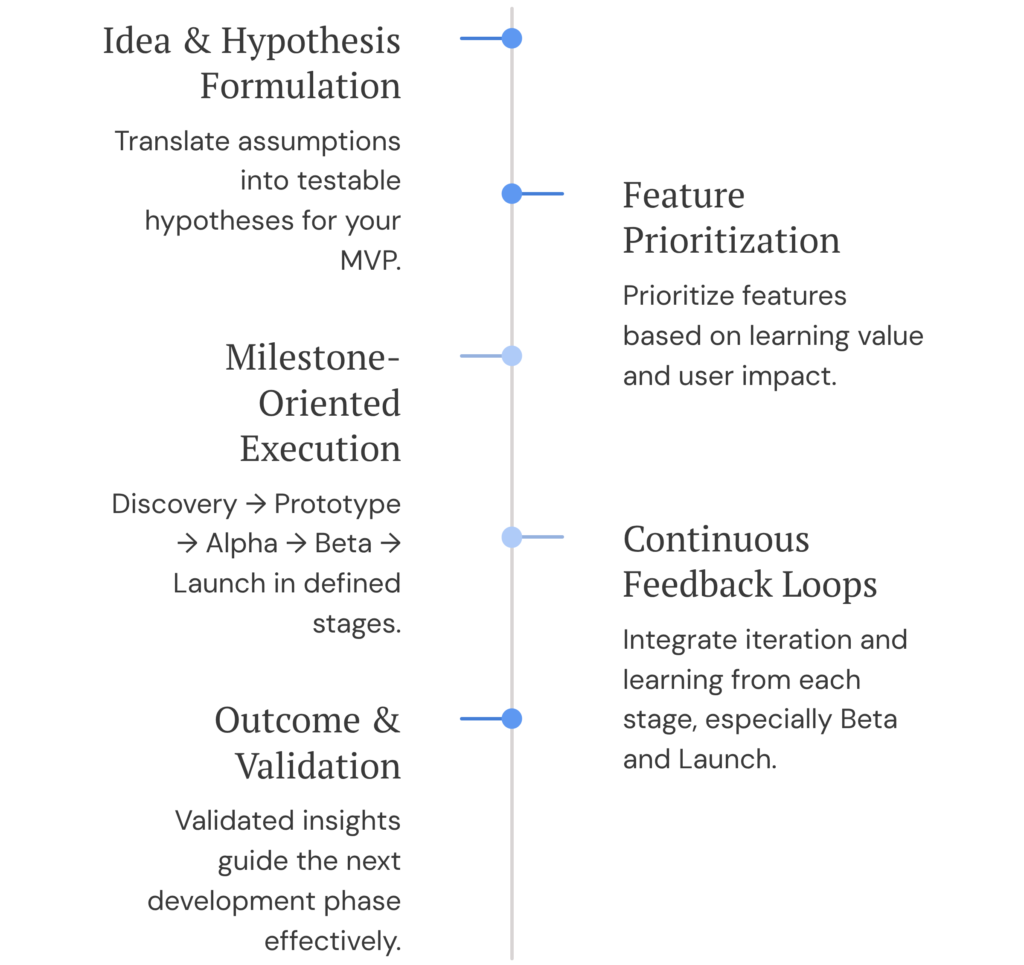
What Should Be Included In A Product Roadmap And Why It Is Important
A product roadmap is not merely a schedule of tasks; it is a strategic blueprint that connects your vision to concrete milestones and measurable outcomes. At its best, a roadmap lays out a sequence of deliberate choices about what to build first and why, grounded in what you expect to learn from real users. Including clear success metrics from the start helps teams distinguish between building output and driving validated learning, which is the essence of a startup MVP strategy. (source)
When a roadmap clearly defines priorities based on user impact and learning potential, the product team can focus on delivering value incrementally, reducing uncertainty, and increasing the likelihood of uncovering actionable insights early. By structuring work around hypotheses rather than assumptions, teams reduce the risk of spinning development cycles without validation. Prioritization tools and frameworks help align development around what matters most first, which in turn informs confident decisions about next steps and resource allocation. (source)
Expert Principles For Building A Confident Product Roadmap
The following are the core principles that ensure a roadmap guides development with clarity and purpose while supporting informed decision-making:
- Strategic Hypothesis Framing: Begin by translating the core idea into testable hypotheses that describe what you believe will resonate with users. This gives your roadmap a clear purpose and anchors every feature decision to an explicit learning objective, reducing the chance of scope creep and making each milestone meaningfully measurable.
- Feature Prioritization With Purpose: Use frameworks that contrast effort with the value of learning, so that you build only what will teach you something essential about your users. Prioritizing in this way fosters confidence because you are measuring progress against real-world feedback instead of speculative intuition.
- Milestone-Oriented Execution: Break the roadmap into clear stages such as discovery, prototype validation, alpha testing with a controlled audience, and broader beta launch. These milestones create natural opportunities for assessment and adjustment that keep development aligned with validated insight rather than assumptions.
Key Actions to Improve Your MVP Development Approach
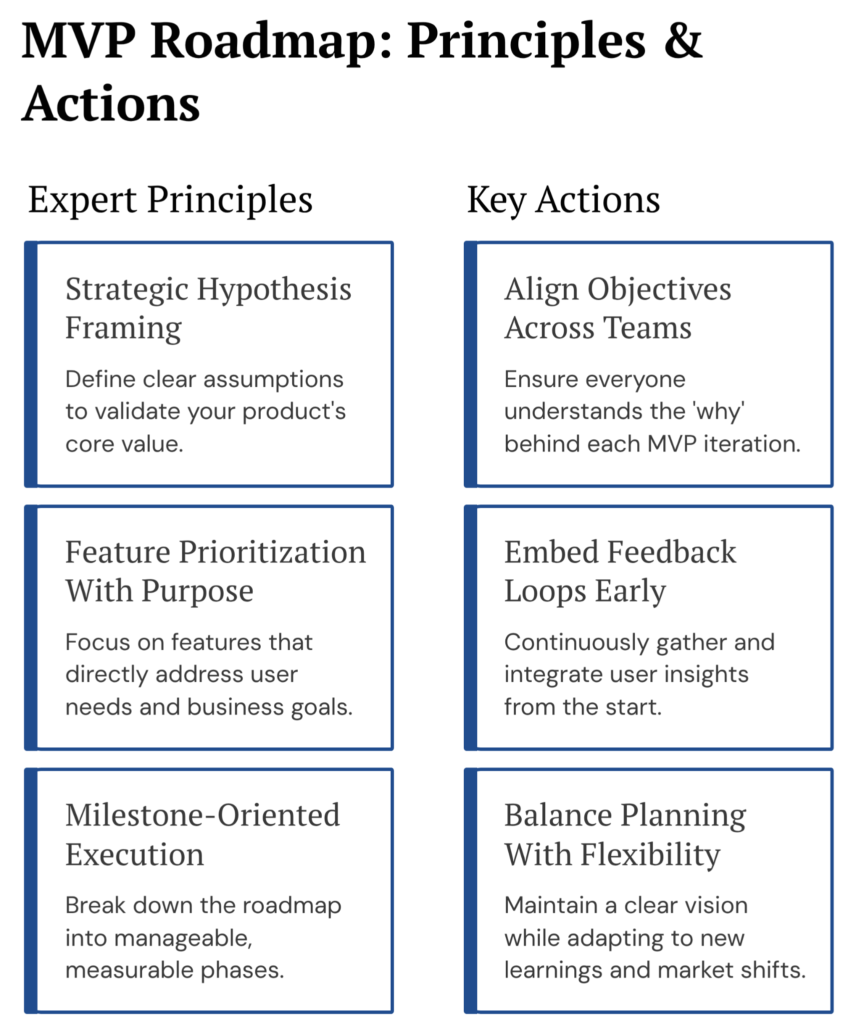
The following are actionable steps that help translate the roadmap principles into measurable progress and maintain alignment across teams:
- Align Objectives Across Teams: Make sure every team member understands why each feature exists and how its success will be measured, so alignment is built into execution rather than assumed.
- Embed Feedback Loops Early and Often: Launch to a smaller group of real users early to gather actionable feedback. Teams that collect feedback throughout the development process are better positioned to adapt the roadmap based on real behaviour and evidence. (source)
- Balance Planning With Flexibility: A roadmap should serve as a guide, not a rigid plan. Regular checkpoints for reviewing insights and adjusting priorities help ensure that you adapt to new information without losing sight of your core goals.
What Improves When You Get The Roadmap Right
When teams invest in structured planning that balances clarity with practical execution, the effects ripple outward across the product lifecycle. Clear roadmaps help prevent wasted effort on features that do not validate core assumptions, leading to prioritizing MVP features that truly matter to users. This clarity reduces uncertainty and provides teams with a framework for measurable progress that boosts confidence at every stage of MVP development and company engagement. Development cycles become more predictable, communication channels become clearer, and the entire team gains a shared sense of purpose anchored in evidence rather than conjecture.
A thoughtful roadmap also makes it easier to communicate strategy with external stakeholders such as investors or advisors because it translates abstract goals into evidence‑based plans and outcomes. Instead of debating priorities internally, teams can make decisions rooted in validated learning, which enhances execution quality and preserves focus throughout development.
Wrapping up
The journey from idea to a validated product is rarely linear, and uncertainty is an inherent component of early-stage development. Success comes from navigating this uncertainty through a structured approach that transforms assumptions into actionable insights. Designing a roadmap with clarity, prioritizing critical features, and embedding regular feedback loops ensures that each development cycle delivers measurable learning and informed decision-making. This approach strengthens execution, aligns teams around shared objectives, and provides a foundation for confident progression at every stage.
For startups aiming to translate strategic vision into tangible outcomes, a product roadmap collaboration partner like Toolagen Technology Services offers the expertise and structured guidance necessary to maintain momentum, accelerate validation, and make each milestone purposeful throughout the MVP development process.
FAQs
- How do I plan an effective MVP roadmap?
Begin by framing your core assumptions as hypotheses and then organize your work around testing them. Prioritize items based on how much you will learn from them and set up regular checkpoints to assess real user feedback. - What features should I include in my first MVP?
Focus on the smallest set of features that will solve your primary user problem and deliver measurable insight. Keep secondary features for later iterations once you have validated the core experience. - How to prioritize product development tasks?
Prioritization should balance effort and the value of insight you expect to gain, so that early development generates the most actionable feedback and informs future decisions. - How do startups build a confident roadmap?
Startups build confidence through clarity in their hypotheses, disciplined feature sequencing, and frequent feedback loops that confirm or challenge assumptions with real user data. - Can I adjust my MVP roadmap after launch?
Adjustments are a natural part of the iteration process, with each change guided by insights into user behavior and product performance. For structured support in refining these plans, a startup product development partner like Toolagen Technology Services can provide proven guidance.